
Home · SOP library · Shimadzu LCsolution
VA-SOP-LC-005 · Standard operating procedure
System suitability parameters (tailing, theoretical plates, resolution) in LCsolution
SOP with screenshots: set USP/EP calculation, column length and t0 in LCsolution, show tailing, plates, resolution, HETP and alpha, and judge PASS/FAIL.
| SOP No. | VA-SOP-LC-005 |
|---|---|
| Revision | 00 |
| Effective date | 30 October 2026 |
| Review date | 30 October 2027 |
| Software | Shimadzu LCsolution 1.25 (Postrun Analysis), LC-2010 series HPLC |
1Purpose
To configure and read column performance (system suitability) parameters in LCsolution and judge them against acceptance limits.
2Scope
Applies to LCsolution 1.2x LC Data Analysis — Performance tab and Peak Table style.
3Responsibility
- Analyst — performs the procedure and records results.
- QC reviewer — verifies the output against the acceptance criteria.
- Lab in-charge / system administrator — controls method and report-format files and user rights.
4Definitions and abbreviations
| N (theoretical plates) | Column efficiency. |
|---|---|
| T (tailing factor) | Peak symmetry at 5 % height (USP). |
| Rs (resolution) | Separation between adjacent peaks. |
| HETP | Height equivalent to a theoretical plate (um). |
| alpha (separation factor) | Ratio of retention factors of two peaks. |
5Prerequisites and materials
- Data file with at least two peaks (for resolution).
- Column length known (mm).
6Safety and precautions
- Work on a copy of data and method files until the change is approved.
- Never delete or overwrite raw data (.lcd) to obtain a passing result; every change must be traceable.
- Follow the laboratory's data-integrity and audit-trail SOP when LCsolution security is enabled.
7Procedure
-
7.1
Read the results
The peak table shows Resolution 0.898, Plates 5355 and Tailing 1.21.
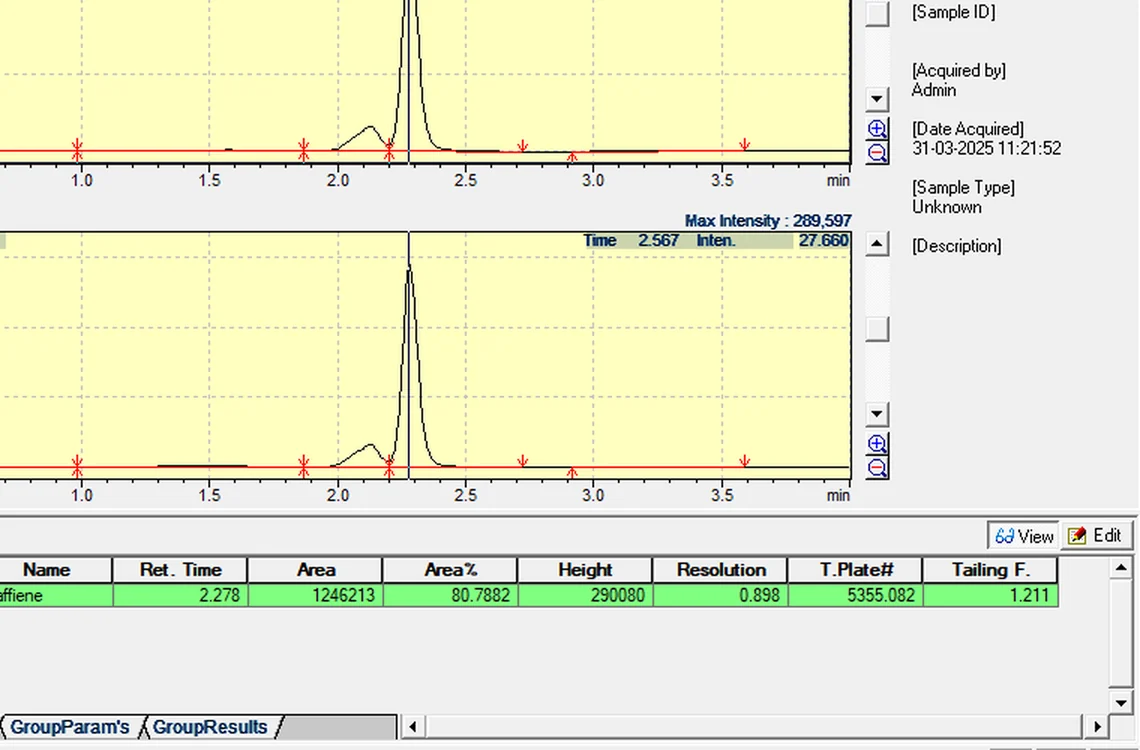
Fig. 7.1 — Read the results -
7.2
Open the Performance tab
Method → Data Analysis Parameters → Performance.
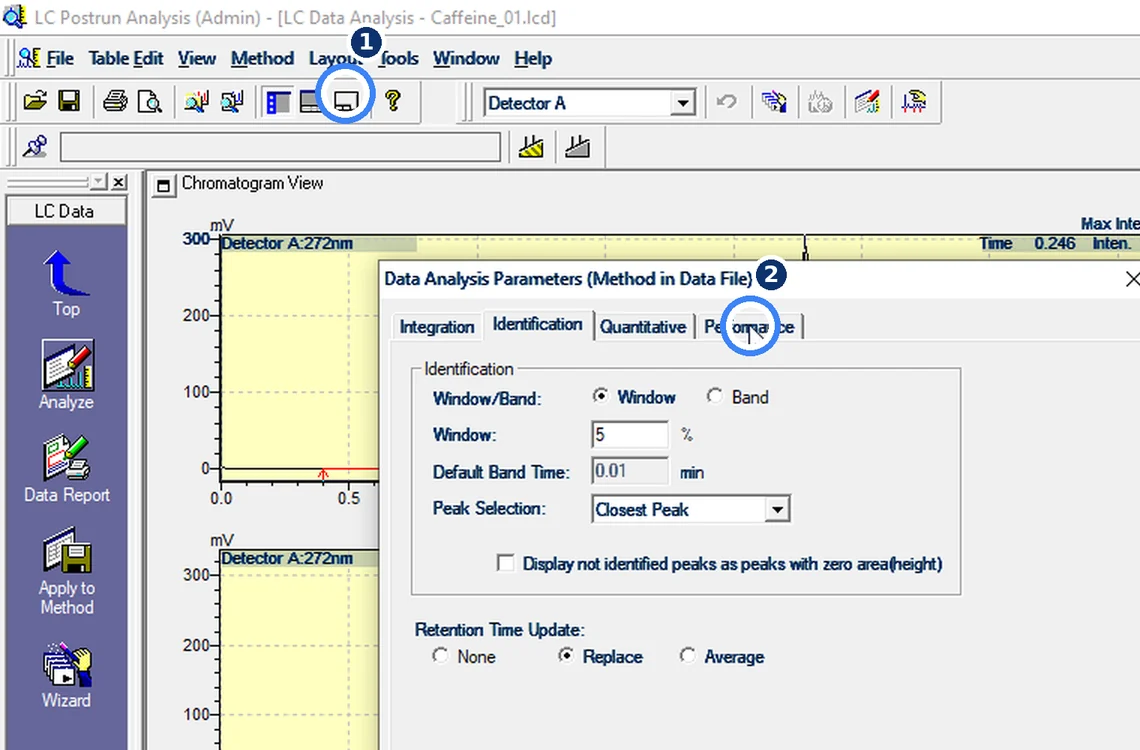
Fig. 7.2 — Open the Performance tab -
7.3
Set the calculation basis
Calc Method USP (or EP/JP/BP), Column Length 150 mm, unretained peak (t0) = first peak. OK.
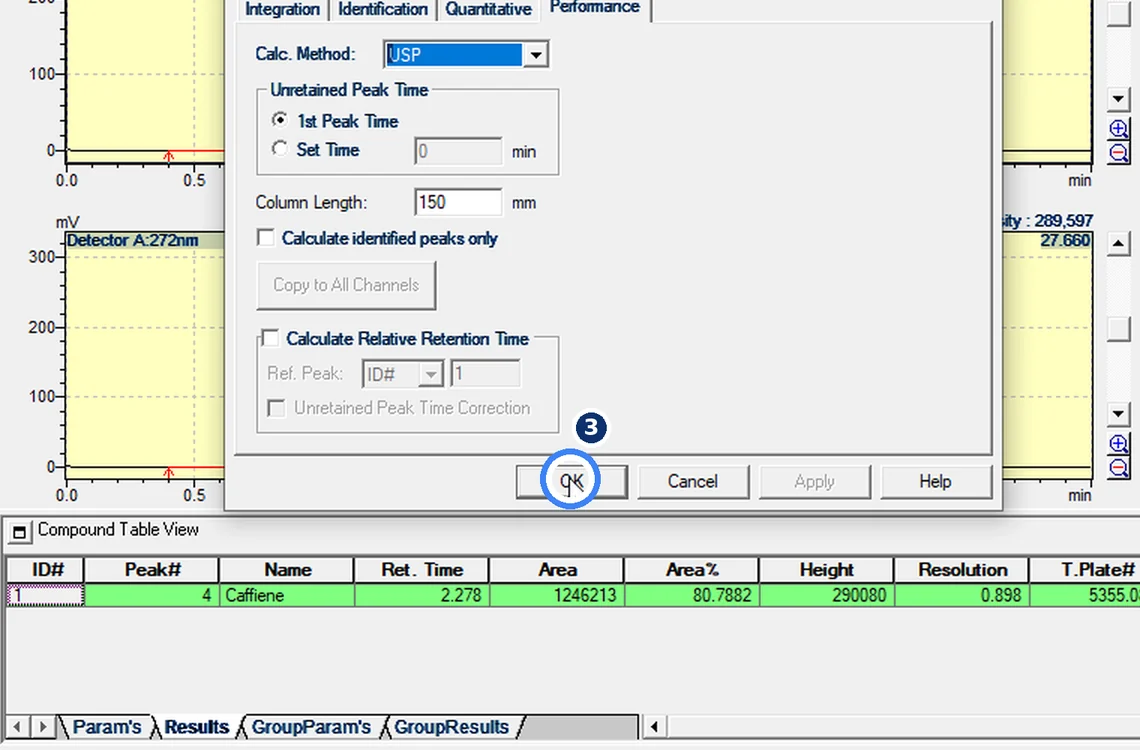
Fig. 7.3 — Set the calculation basis -
7.4
Add columns to the table
View → Table Style: add HETP and Separation (alpha).
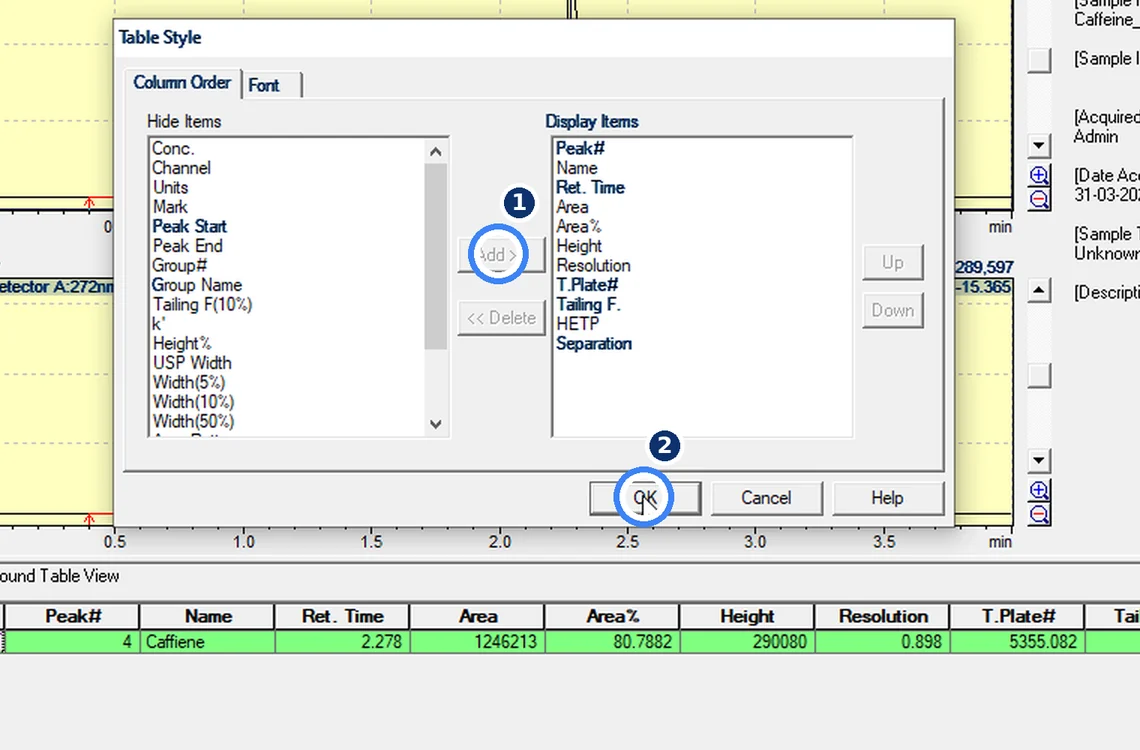
Fig. 7.4 — Add columns to the table -
7.5
Read the extra values
Scroll the table: HETP 28.0, alpha 1.12.
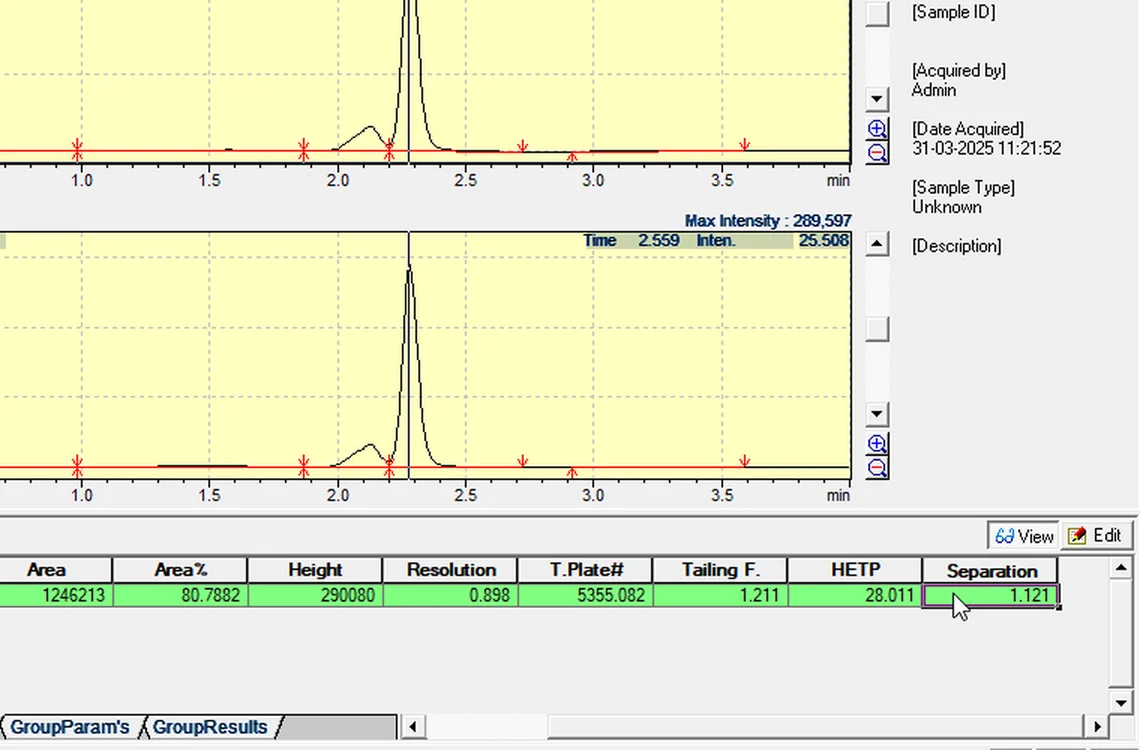
Fig. 7.5 — Read the extra values -
7.6
Judge PASS / FAIL
Plates > 2000 PASS, Tailing < 2 PASS, Resolution 0.898 < 2 FAIL.
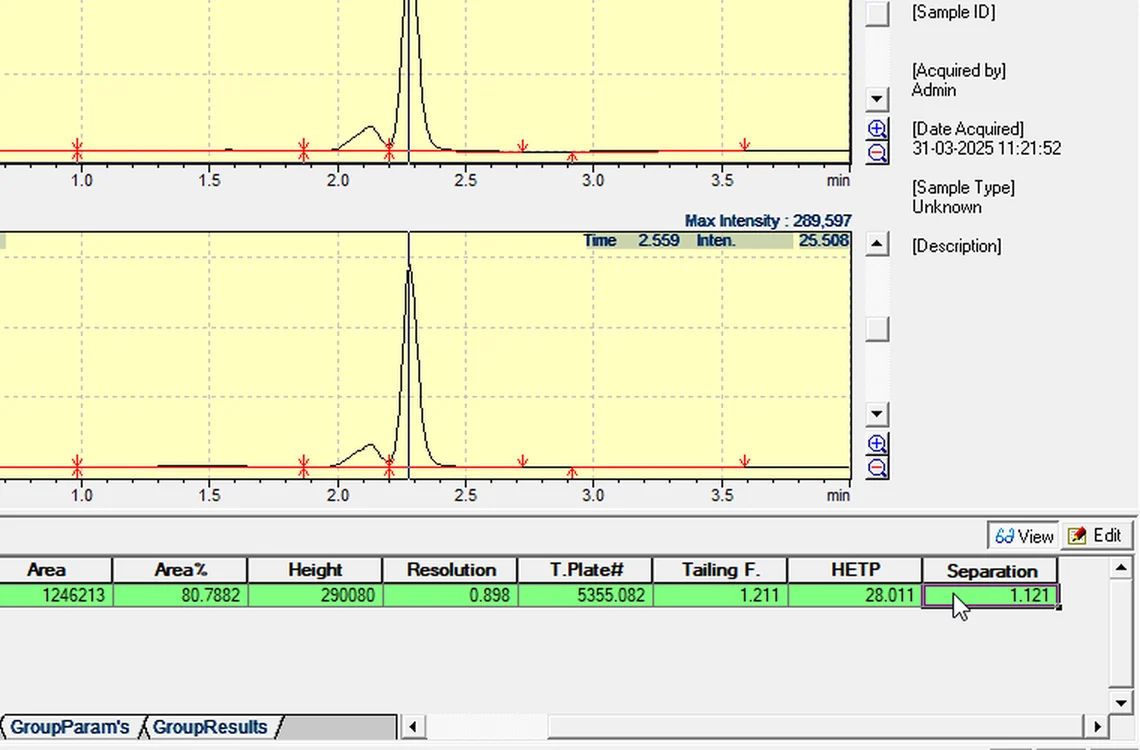
Fig. 7.6 — Judge PASS / FAIL -
7.7
Act on a failure
Low resolution is fixed in the chromatography (mobile phase, column), never by changing integration.
8Acceptance criteria and interpretation
- Typical USP limits (confirm with the monograph): Plates > 2000, Tailing <= 2.0, Resolution >= 2.0, Area %RSD <= 2.0 % (n = 5–6).
- Demonstration: Plates 5355 PASS, Tailing 1.21 PASS, Resolution 0.898 FAIL.
9Troubleshooting and common errors
| Symptom | Cause and fix |
|---|---|
| Resolution fails | This is a chromatography problem, not a software one: adjust mobile phase/gradient, replace or change the column. |
| Plates far too low/high | Check column length and the Calc Method (USP/EP/JP/BP) in the Performance tab. |
10References
- Shimadzu LCsolution Ver. 1.2x — Operation and Help documentation.
- USP <621> Chromatography.
- ICH Q2(R2) Validation of Analytical Procedures.
11Revision history
| Rev. | Date | Change |
|---|---|---|
| 00 | 30 October 2026 | First issue, written from the October 2026 screen recording. |
Frequently asked
Where are tailing factor and theoretical plates in LCsolution?
Set the calculation in Method → Data Analysis Parameters → Performance (USP/EP/JP/BP, column length, t0), then add the columns through View → Table Style of the Peak Table.
Video version: LCsolution — Where are tailing, plates and resolution? (October 2026) — on our Instagram and YouTube.
Related SOPs
Vision Analytical is an independent service provider, not affiliated with Shimadzu Corporation or Waters Corporation. LCsolution and Empower are trademarks of their respective owners. Screenshots are from our own demonstration systems with demonstration data. Last updated 30 October 2026.